Annual world production (2022)

Rhenium
Rarer than Gold
What is Rhenium?
Rhenium was discovered late, in 1950. This may be because, at only 0.7 micrograms per kilogram, it is the rarest non-radioactive metal on Earth. Rhenium is a byproduct of copper extraction and is about as rare as gold. It does not occur in its pure, native form in the Earth’s crust, which significantly complicates its extraction. Rhenium is mined from copper mines. In the three years from 2013 to 2016, only nine new deposits were discovered. It takes about 20 years for such a mine to become operational. Thus, the supply of copper ores over the next 15 to 20 years is very concerning. This shortage also affects the extraction of rhenium. Primary production has already stagnated for several years at the low level of under 50 tons. Rhenium is therefore the rarest industrially used metal. Its global reserves are estimated at a total of only 2,400 tons. Just two years ago, global reserves were well over 100 tons higher. For comparison, annual gold production is approximately 3,500 tons.

Price Development
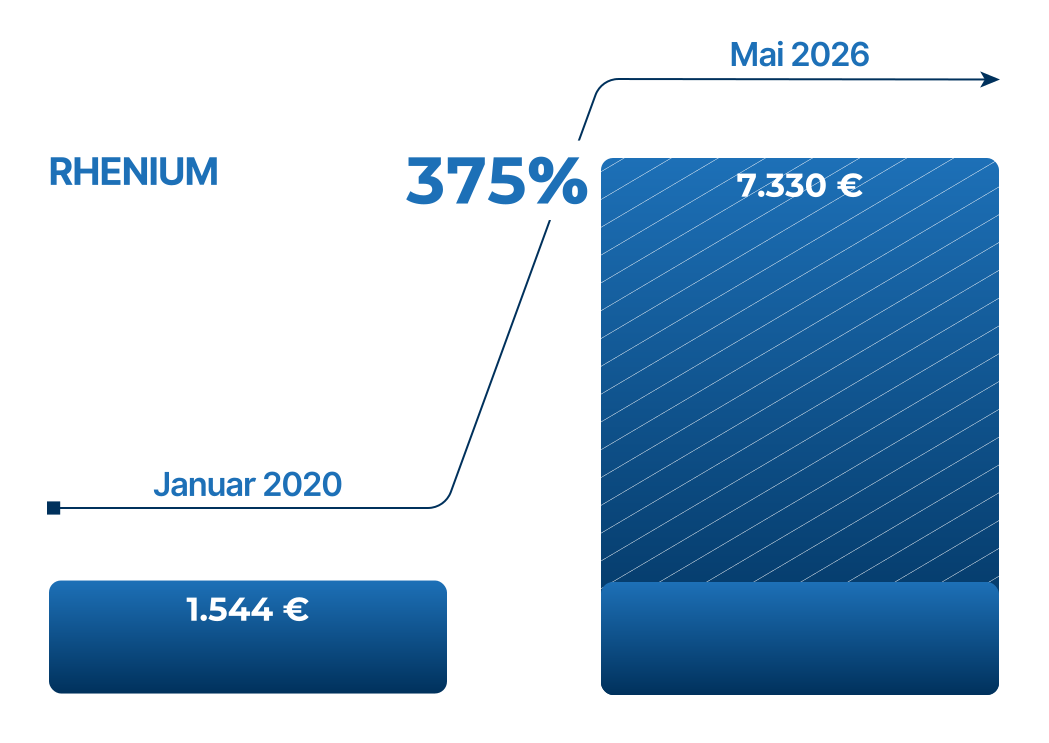
Rhenium is one of the rarest technology metals found in the Earth’s crust, yet its price has not risen for a long time. Now, however, we are experiencing the long-awaited price breakout upwards. One reason for this is certainly the recovering aviation industry, but also the increased production costs due to rising energy costs are now apparently being passed on to consumers. Rising prices for this technology metal can also be expected in the future. The EU Commission has emphasized the importance of superalloys for future technologies in a study. The development of these materials is increasingly moving towards high-temperature applications, as shown by patents filed between 2015 and 2019. Therefore, there is no way around Rhenium in the future.
Main Applications
- Gas Liquefaction
- Engines/Turbines
- Catalysts
- Medical Applications
- Aerospace
- Superatomic Semiconductors (Re6Se8Cl2)

Facts about Rhenium
Estimated share of our inventory in the AWP
Estimated increase in demand
Global reserves
Where is Rhenium found?
Rhenium occurs in some ores, but always in bound form. Since rhenium has similar properties to molybdenum, it is primarily found in molybdenum ores. These can contain up to 0.2% rhenium. Other rhenium-bearing minerals include columbite (Fe,Mn)[NbO3], gadolinite Y2FeBe[O|SiO4]2, and alvite ZrSiO4. The so-called Mansfeld copper shale also contains small amounts of rhenium. The largest deposits of rhenium-bearing ores are located in the United States, Canada, and Chile. Some deposits also exist in Poland.
How is Rhenium extracted?
When molybdenum ores, particularly molybdenite, are roasted during molybdenum extraction, rhenium accumulates as volatile rhenium(VII) oxide in the fly ash. This can be converted into ammonium perrhenate (NH4ReO4) using ammoniacal water. Subsequently, the ammonium perrhenate is reduced to elemental rhenium with hydrogen at high temperatures.

What is Rhenium primarily used for?
Rhenium is a shiny silver-white metal and is mainly used as an admixture in heat-resistant super alloys. After tungsten, it is the metal with the highest melting point. This is 3,182° Celsius. This makes rhenium ideal for use in aircraft engines, which have to withstand high temperatures during operation, as well as in turbine blades for liquefied gas production and thermocouples.
It is also used in the production of lead-free gasoline and in catalysts. Rhenium also helps in medicine: as a thin foil applied to the body, it can treat white skin cancer without leaving surgical scars.
Loading
Price Development of Rhenium
Rhenium is one of the rarest technology metals found in the Earth’s crust, yet its price has not risen for a long time. Now, however, we are experiencing the long-awaited price breakout upwards.
One reason for this is certainly the recovering aviation industry, but also the increased production costs due to rising energy costs are now apparently being passed on to consumers.
Rising prices for this technology metal can also be expected in the future. The EU Commission has emphasized the importance of superalloys for future technologies in a study. The development of these materials is increasingly moving towards high-temperature applications, as shown by patents filed between 2015 and 2019. Therefore, there is no way around Rhenium in the future.