Annual world production (2022)

Gallium
The essence of sustainable technologies
What is gallium?
Gallium is a silvery-white, easily liquefiable metal. It is a chemical element with the symbol “Ga” and atomic number 31 in the periodic table of elements. Gallium melts at just 29.8 degrees and does not boil until 2403 degrees. This gives it the largest liquid range of all metals. The technology metal also exhibits a density anomaly, as it is denser in a liquid state than in a solid state. Furthermore, gallium is the basis of several piezoelectric compounds such as gallium arsenide (GaAs), gallium phosphide (GaP), and gallium nitride (GaN). These are materials that generate electrical charges when under pressure. These properties ensure an ever-expanding range of applications for the metal and are difficult or impossible to substitute. Gallium that the industry can use must first be extracted from natural sources and then purified through various processes.

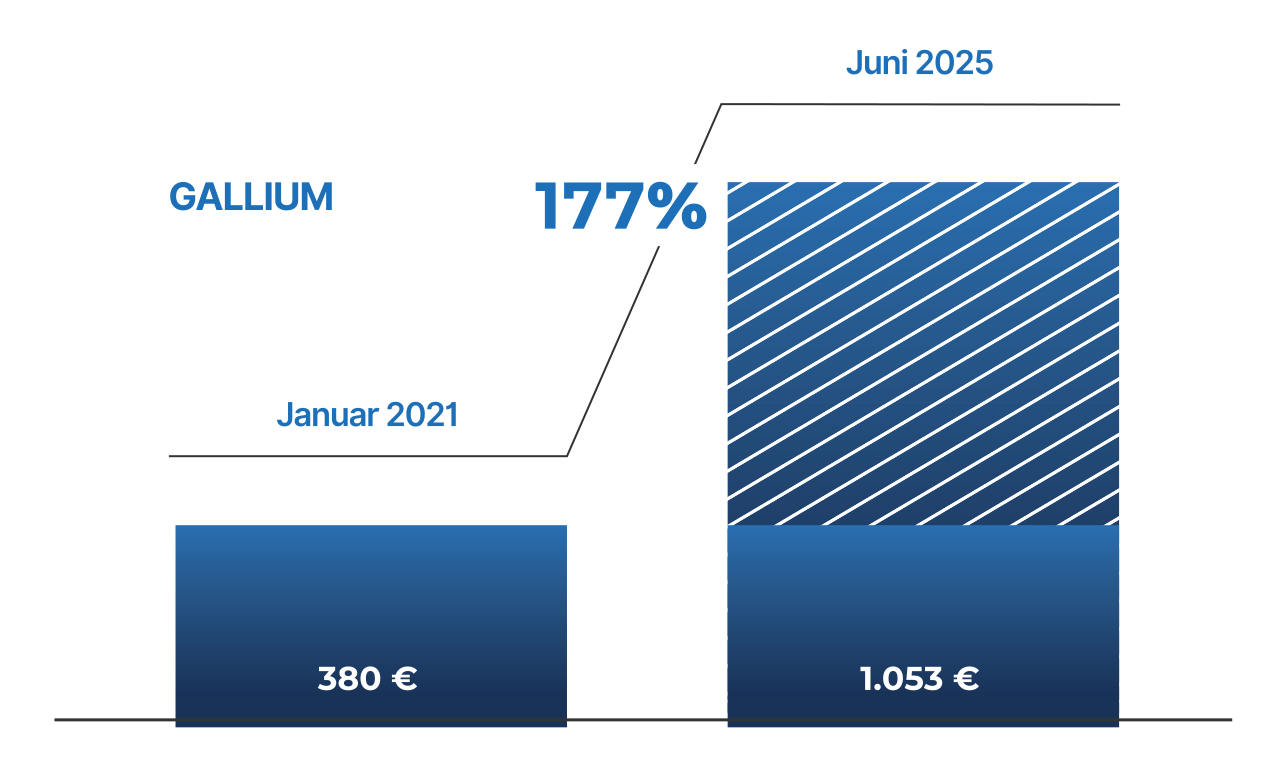
Price Development
As a coolant for computers, a component of light-emitting diodes and semiconductor electronics, and as a means of generating green hydrogen, gallium is a metal with a future. It is no wonder that prices exploded in the face of short-term delivery stops. Only recently, imports were restricted again by China. The resulting rising prices offer a good (re)purchase opportunity.
Main Applications
- Integrated circuits
- LEDs
- Alloys, batteries, magnets
- Solar technology
- Green hydrogen
- Computer cooling systems

Facts about gallium
Estimated share of our inventory in the AWP
Estimated increase in demand
Global reserves
Gallium is a critical commodity
71% of the gallium used in the EU comes from China. Due to the Chinese export controls for gallium (and germanium) in effect since August 1, there is a possibility of an increasing shortage of this critical commodity. A commodity is considered “critical” if it is strategically significant but only finitely available. According to a study by Ernst & Young commissioned by the government, gallium is one of the 39 critical commodities on which Germany is dependent on imports. To establish its own supply, Europe urgently needs its own refineries and supply chains located outside of China. Setting these up could still take many years.
Where does gallium occur?
Gallium occurs only to a small extent in nature. The metal is usually found as an admixture in aluminum, zinc, or germanium ores. The most important deposits with the largest occurrences are located in China, Russia, Canada, and Australia. The highest gallium content, at over 1%, is found in the germanite ores of the Apex Mine in the US state of Utah. The technology metal is rare in the Earth’s crust, at about 18 parts per million. This makes its abundance comparable to that of lithium and lead.
How is gallium extracted?
Gallium is a byproduct of zinc and aluminum production and is obtained by extraction from the residues of these ores. When produced from aluminum, a multi-stage process first creates gallium hydroxide mixed with aluminum hydroxide. The mixture is then dissolved in a sodium hydroxide solution and the gallium is extracted through electrolysis. Subsequently, the gallium is refined and used for various applications in technology and industry. The entire process is very energy- and labor-intensive. Therefore, it is only applied in countries with low costs for this, such as China.

What is gallium mainly used for?
Gallium is used in key technologies relevant to defense capability, transport, communication, and healthcare. This makes it indispensable for a country’s critical infrastructure. Specifically, the technology metal is used in high-frequency components such as integrated circuits and transistors, as well as in optoelectronic components like LEDs. Gallium is also an important commodity for photovoltaic technology, for example as a component of the highly efficient CIGS solar cell. Furthermore, gallium plays a role in self-repairing circuits and as a contrast agent in cancer therapy. In addition, the metal is indispensable in the 5G mobile communications standard and in the expansion of fast-charging stations for electric cars.
Gallium is also used in water treatment and in the fight against antibiotic-resistant germs. In the future, the commodity will play an important role in fuel cells and energy storage technologies. In addition, gallium is used in innovative applications, for example as a reversible adhesive that adheres temporarily. Medical technology also incorporates the metal into piezoelectric micro-robots that provide improved mobility for biological samples. Gallium now also enables the construction of larger robots made of liquid metal, which can be used for repairs on inaccessible machine parts. In the video below, you can see how a liquid metal robot made of gallium and neodymium oxide flows under a grate door and then regains its shape:
Loading
Price development of gallium
Based on the diverse applications described and the increasing demand for gallium in various growing markets such as photovoltaic technology, medical technology, mobile communications standards like 5G, and electromobility, a long-term increase in demand for gallium is to be expected. This could lead to a rise in gallium prices. Particularly in view of the ambitious goals for renewable energies and electric mobility, the demand for gallium is likely to remain high in the long term, which promises opportunities for attractive returns for investors over the long term.