Annual world production (2022)

Indium
The New Silver of the Digital World
What is Indium?
The heavy metal indium belongs to the boron group in the periodic table of elements and is considered one of the first elements whose natural occurrences will soon be completely depleted. This was supposedly expected to happen as early as 2013. Its occurrence in the Earth’s crust is only 0.05 parts per million, which is roughly equivalent to the rarity of silver and mercury. With a Mohs hardness of 1.2, indium is so soft that it can be cut with a knife. Most of us have probably held indium in our hands, as a thin layer of it is found on the touchscreens of mobile phones. Not only because of its use in electrifiable surfaces, indium is indispensable, especially for the electronics industry, and is therefore considered a strategic metal. Due to its scarcity, this technology metal is also classified as a critical commodity.

Price Development
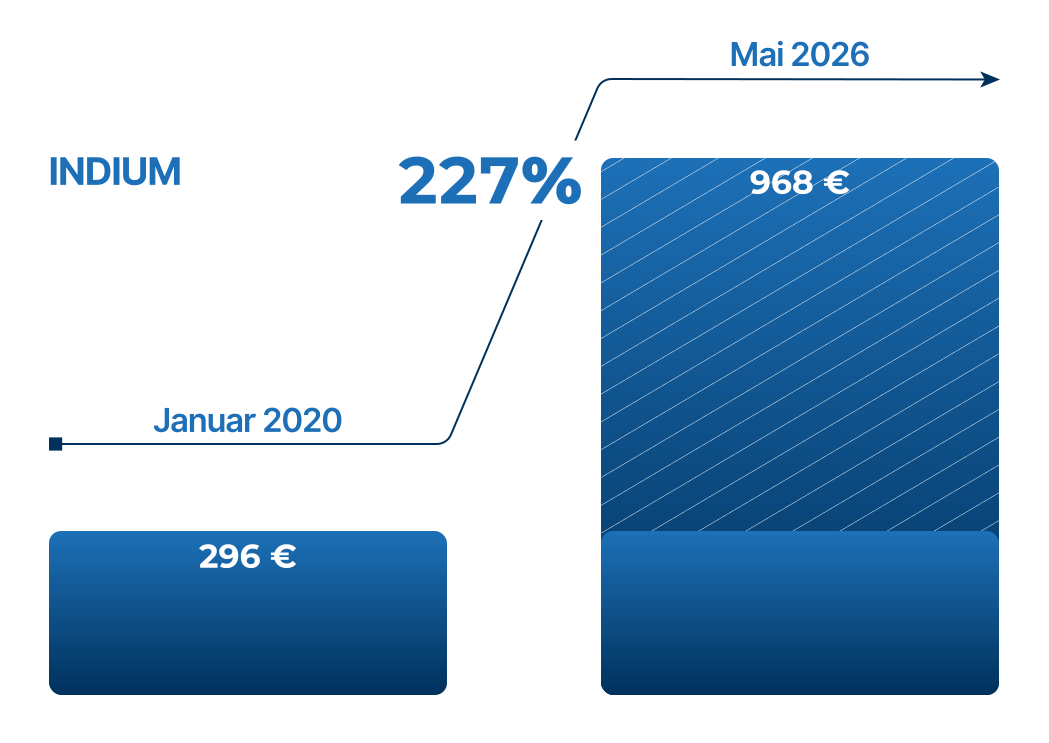
According to the USGS, indium experienced a price increase of 463% between 2001 and 2004. This could be related to the static reserve base, meaning the period after which both the occurrences and the established reserves of the metal are expected to be depleted. In 2006, the USGS estimated this to be about 13 years for indium, an underestimation, as there would be no indium left today if that were true. Nevertheless, the scarcity of the metal and demand from various, sometimes changing, industrial sectors have led to price surges in the past. Even today, the metal reacts very sensitively to potential supply shortages. For example, its price shot up sharply after China announced export controls on gallium and germanium – even though indium was not affected at all.
Main Applications
- Solar cells
- Semiconductors
- Photodiodes
- Integrated circuits
- Corrosion Protection
- Touchscreens

Facts about Indium
Estimated share of our inventory in the AWP
Estimated increase in demand
Global reserves
Where is Indium found?
Indium occurs in some sulfidic minerals such as indite and roquesite, but the majority is found in zinc ores, especially sphalerite. Native indium has only been discovered in a single find in eastern Siberia. The largest occurrences of zinc, and thus indium, are in China, Peru, Canada, Australia, and the USA. Smaller amounts of indium-containing ores are also found in Bolivia, Brazil, Japan, Russia, South Africa, and some European countries.
Small amounts of indium have also been discovered in Germany, for example in Freiberg and Marienberg in the Ore Mountains and at Rammelsberg in the Harz Mountains. In the primary extraction of indium, China leads with 50%, followed by Belgium, Canada, Peru, and South Korea. The theoretical reserves of indium amount to approximately 6,000 tons, of which only 2,800 are economically extractable.
How is Indium obtained?
Indium does not occur naturally in its elemental form. Since targeted indium extraction would be uneconomical, it is only obtained as a byproduct during zinc and lead production. 90% of the extracted metal comes from the flue dusts generated during zinc sulfide smelting. To extract indium in this manner, a solution of sulfuric or hydrochloric acid is used. The actual indium extraction is carried out by electrolysis, using a solution of indium(III) chloride in hydrochloric acid. The indium(III) chloride is then converted into elemental indium using mercury electrodes. To obtain the over 99.99% pure indium highly demanded by industry, the crude product must be further refined using zone melting processes or repeated electrolysis of indium(I) chloride molten salts.

What is Indium primarily used for?
Indium is an indispensable part of our daily lives, as it is found in almost all modern devices. Most people know it as a wafer-thin conductive layer of indium tin oxide on their mobile phone touchscreens. However, indium is also found in computers and in the photodiodes of modern digital cameras. The semiconductor indium(III) sulfide is used in the construction of solar cells due to its specific band gap. In thin-film solar cells, copper indium diselenide is used because of its high light absorption rate.
The CIS solar cells built with it are among the most powerful solar cells in this field, with an efficiency of over 19%. Indium is also used in nanotechnology. Due to their special photoluminescence, indium phosphide nanowires are installed in highly sensitive photodetectors and optical switches. As a cold-resistant superconductor, indium also enables quantum computers to operate faster and more accurately.
Loading
Indium Price Development
According to the USGS, the price of indium rose by 463% between 2001 and 2004. This could be related to the static range of the reserve base, i.e. the period of time after which both the deposits and the invested reserves of the metal are expected to run out. In 2006, USGS estimated this to be around 13 years for indium, a misjudgement as there would already be no indium left today.
Nevertheless, the scarcity of the metal and demand from various, sometimes changing, industrial sectors have led to price surges in the past. Even today, the metal reacts very sensitively to potential supply shortages. For example, its price shot up sharply after China announced export controls on gallium and germanium – even though indium was not affected at all.