Three investment strategies - one consequence: why commodities are becoming the decisive basis
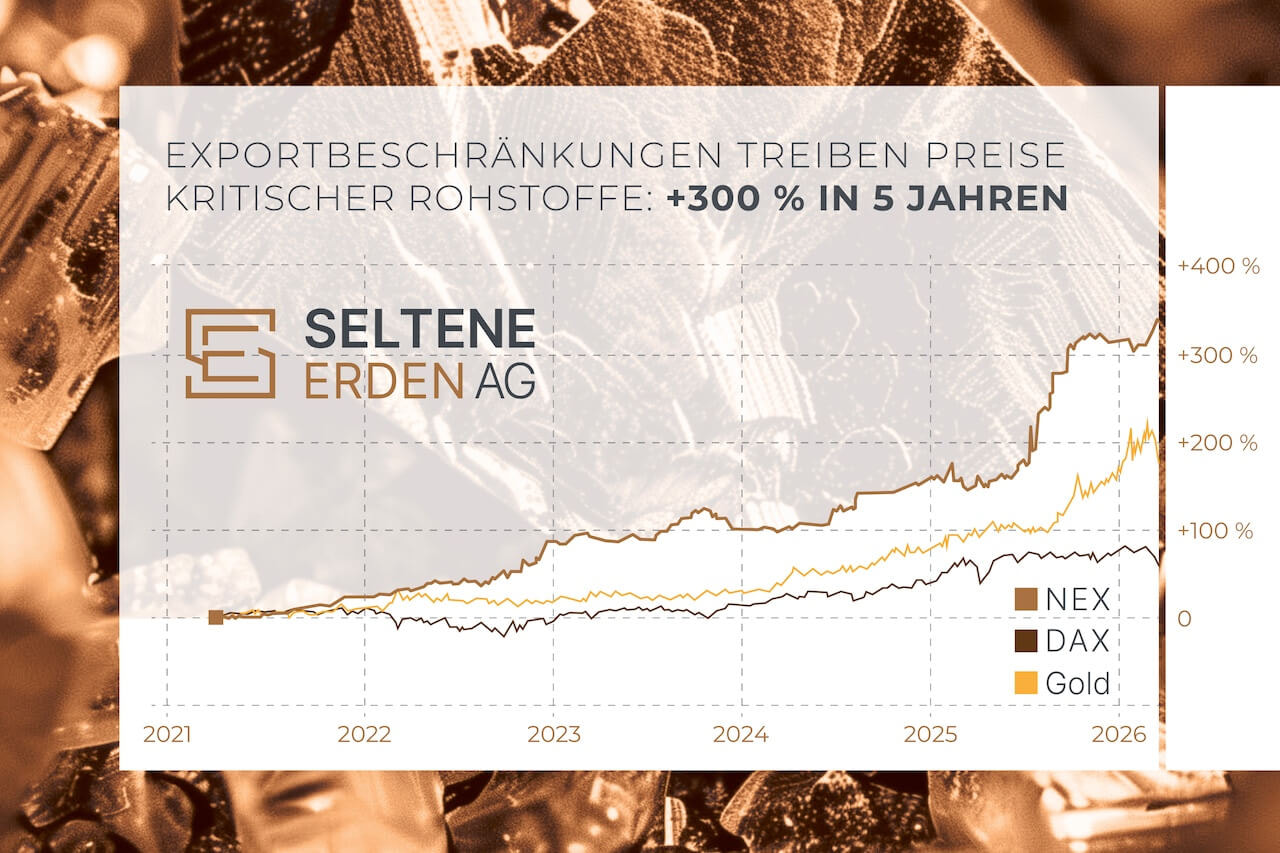
Financial experts from London and Singapore recommend three strategies for volatile markets: Infrastructure instead of individual stocks, commodities instead of a focus on equities and more diversification outside the US. At first glance, these approaches seem different. In fact, they all lead to the same result: it is no longer a question of betting on winners, but of controlling the basis of these winners. In a world of geopolitical tensions, technological change and fragile supply chains, the focus is shifting. It’s not the next stock that determines success, but access to the resources without which nothing works.
Commodities are the new infrastructure
The “picks and shovels” strategy recommends not buying the winners of a trend, but the infrastructure behind it. However, this starts earlier than many assume – with the commodities themselves. Technology metals and rare earths are the basis of key industries such as electromobility, artificial intelligence, energy supply and defense.
Without materials such as yttrium oxide, gallium, indium or germanium, neither modern semiconductors nor high-performance systems would work.
Elements such as praseodymium oxide or dysprosium oxide are essential for magnet technologies in electric motors and wind turbines, while antimony is used in safety-critical applications and energy systems.
Commodities – especially critical raw materials such as rare earths and technology metals – are therefore not just primary products, but the first stage of industrial infrastructure. Investors here are not positioning themselves in a single sector, but at the basis of the entire global value chain.
True diversification means substance
Another piece of advice is to invest broadly in commodities. However, not every commodity investment actually tracks commodities. Many investors opt for mining shares or commodity ETFs, which primarily reflect companies and not the physical substance itself. This creates dependencies on management decisions, extraction costs, political intervention and financing conditions – factors that are often only indirectly related to the real scarcity of commodities.
True diversification only comes about when the focus is on physical substance. This applies in particular to investments in rare earths and technology metals. An investment that is directly linked to availability, demand and scarcity follows different, more stable laws than a company. Commodities themselves carry no risk of insolvency – their value arises from their indispensability in industrial processes.
Let's bring these metals to Europe
Following the Iran conflict, experts expect setbacks on the stock markets and recommend reducing exposure to the USA and repositioning globally. What initially sounds like a risk is actually a strategic opportunity.
It’s not just about diversification – now is the time to bring added value back to Europe. When capital is withdrawn from overvalued markets, there is room to shift into real assets. This is precisely where the opportunity lies: for Europe, access to critical commodities is becoming a key economic issue.
An investment in technology metals and rare earths is more than just a portfolio decision. It means putting physical commodities where they will be needed in the future. Those who secure access now are not only positioning themselves against market uncertainties – they are securing a place at the basis of the next industrial value creation phase.
Politico picks up on raw material stocks - and we classify
Politico ‘s latest newsletter highlights a topic that underlines the strategic importance of commodities: the restriction of tax-free storage of imported metals in duty-free warehouses. This development could have far-reaching consequences for investors and the industry.
Until now, this model has been a central component of the commodities market. Investors were able to purchase rare earths and technology metals abroad, store them tax-free and sell them to industry when needed. “We are currently supplying the needs of German industry, which is no longer supplied from China, with this stockpile, which is well filled by the financial industry,” explains Andreas Kroll. The decision to restrict this model is “extremely instinctive in the current global situation”.
The effects go beyond the capital market: “Investment flows, storage capacities and therefore also strategically relevant raw material stocks are being relocated abroad.” This shift could make Europe’s access to critical commodities even more difficult – a risk that brings the importance of physical substance and strategic storage back into focus.
Access beats forecast - 300 % price increase due to structural shortage
All three strategies lead to the same core. It is not forecasts that determine investment success, but access. Those who position themselves at the basis of value creation reduce dependencies on market cycles, partially decouple themselves from valuation bubbles and invest in structural bottlenecks instead of short-term trends.
Today, this bottleneck lies in technology metals and rare earths. Demand is rising, supply remains limited – and the market reaction to this has long been visible: export restrictions imposed by dominant producing countries have caused the prices of critical commodities to rise by over 300% in the last six years. This price increase is not a short-term effect, but the result of a structural shortage.
In addition, there is a long-term cycle: many market observers assume that the current commodity cycle will be characterized by rising demand and structural scarcity for another 15 to 18 years. This is precisely where sustainable value comes from.
Consistent implementation
Models that rely on physical substance take up this idea directly. One example is the structure of Seltene Erden AG. Here, the majority of the capital flows directly into physically stored metals, while the portfolio is broadly diversified across several critical rare earths such as neodymium, praseodymium or dysprosium. The focus is not on individual winners, but on the structural bottleneck itself.
The approach thus combines several elements that are often considered separately in traditional strategies: Infrastructure, diversification and real substance. Investors do not invest in expectations, but in physically available, critical commodities.
An additional aspect is becoming increasingly important: access protection. Thanks to its location in Liechtenstein, Seltene Erden AG offers additional country diversification. After all, in an environment of increasing regulation, it is not just ownership that is decisive, but secure access at the crucial moment.
The decisive change of perspective
The real change is not in individual markets, but in thinking. Away from the question of what could rise and towards the question of what is urgently needed. Why invest in rare earths? Because they are critical commodities that form the basis of modern technologies and their supply is structurally limited.
In an uncertain world, it is not the fastest market that counts, but the most stable foundation. And this starts with physically available, critical commodities.