Indium Dealers on Edge: Will the Metal Be the Next Target for Export Controls?
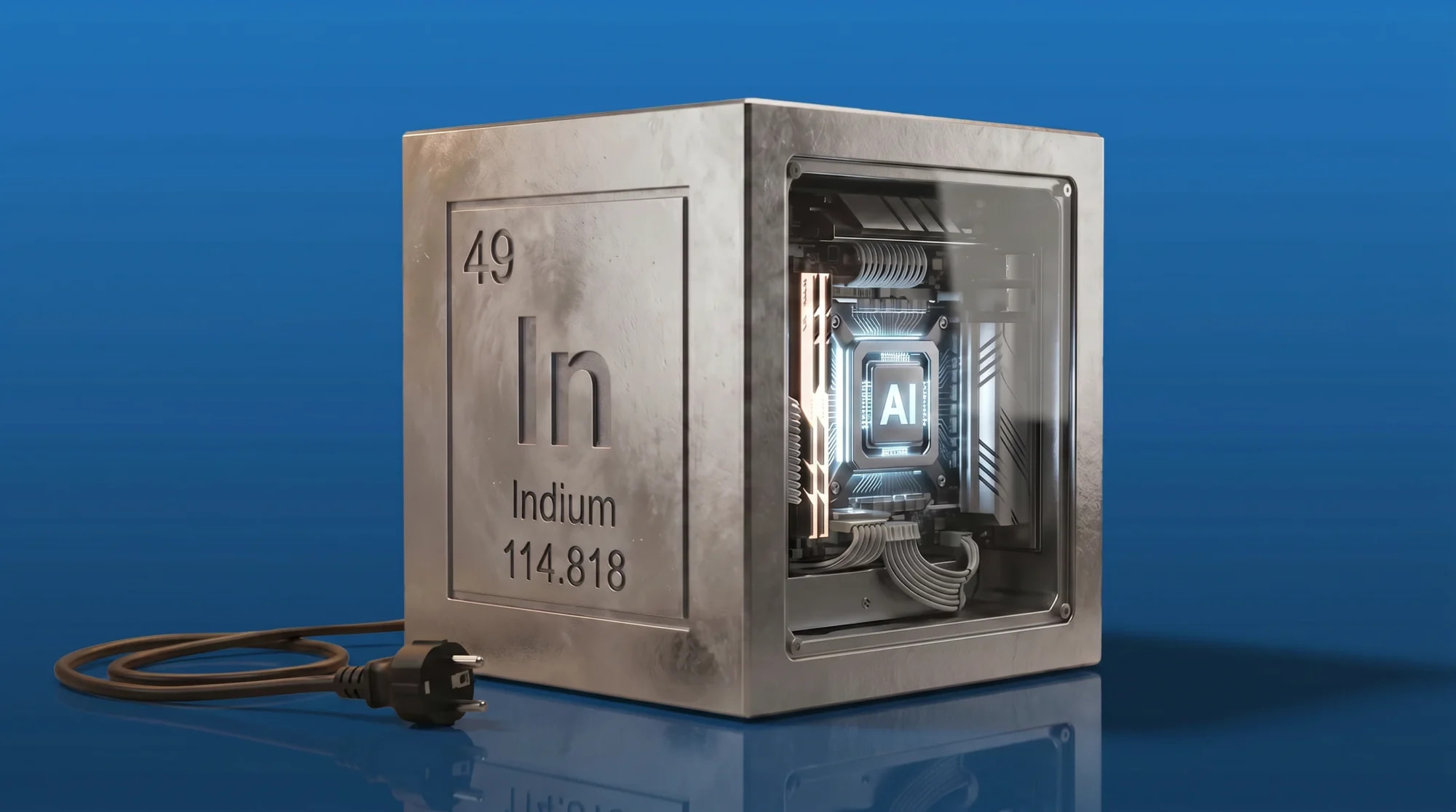
The conflict between China and the U.S. over critical commodities continues to intensify. Indium, a metal that plays a key role in AI, communications, and defense, is now taking center stage.
Beijing is tightening controls
China controls about 70 percent of global indium production—and is increasingly using this market power in a targeted manner. Since February 2025, indium phosphide (InP)—a material essential for high-speed photonic chips in AI data centers—has been subject to Chinese export controls. Now, for the first time, European importers are being asked to provide information on their end users, while North American buyers report noticeably longer processing times. Although there is still no specific regulation for indium metal, concern is growing within the industry that indium could be the next target for Chinese export controls.
Indium at the Intersection of AI and Defense
Indium phosphide is the foundation of high-speed photonic chips—the building blocks that move massive amounts of data between processors in modern AI data centers. But the line between civilian and military AI is blurring. Satellite reconnaissance, autonomous systems, and the analysis of massive data streams: military forces are relying on precisely the technologies that are driving the civilian AI boom. As a result, indium sits at one of the most sensitive junctions in the entire value chain. Whoever controls access to this metal not only controls the development of powerful AI systems but also, indirectly, their military capabilities.
The U.S. Is Building Up Its Capabilities — China Is Targeting Supply Chains
Washington has long recognized the strategic importance of this issue: The Defense Logistics Agency is considering establishing a national indium stockpile of 222 metric tons—nearly the entire U.S. annual consumption of about 250 metric tons. At the same time, the U.S. is advancing its own supply chains to break its dependence on Chinese intermediate products and processing stages.
These efforts are now gaining momentum on the international stage as well. In mid-June 2026, the G7 agreed to resolutely reduce their dependence on individual supplier countries. China was not named. Nevertheless, it was likely clear who the G7 had in mind.
Beijing’s response was swift: sanctions against MP Materials and USA Rare Earth—ironically, the very two key projects aimed at securing a supply of rare earths and magnets independent of China.
The conflict has thus reached a new level of escalation. Whereas the focus had previously been on individual commodities such as gallium, germanium, or rare earths, alternative supply chains themselves are now being targeted. The message is unmistakable: Anyone seeking to establish alternative supply routes must expect pushback in the future.
Is another market shortage on the horizon?
There are currently no export controls on indium metal itself. But the mere possibility is enough to make traders and industry nervous. The market is small, the strategic importance enormous—and at the same time, the U.S. is reviewing a stockpile that amounts to nearly its entire annual consumption. A volatile situation.
In October, Washington and Beijing will meet again for talks on trade and raw materials. Indium could also be on the agenda then. The outcome is uncertain.
For Europe, this raises a pressing question even today: Should the EU also consider building strategic indium reserves?