$120 for oil? Two bottlenecks expose Europe's raw materials problem
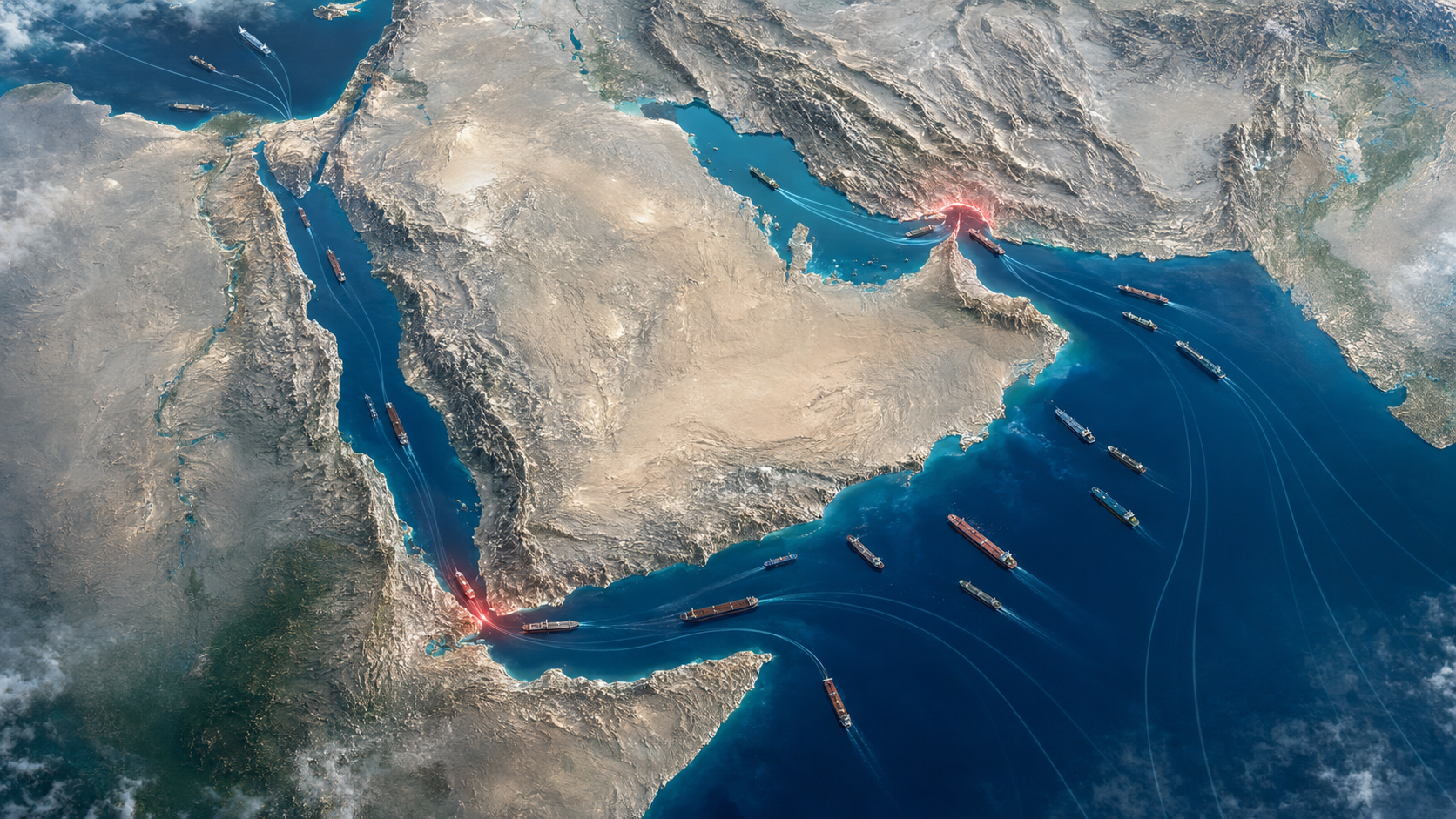
More than $120 per barrel of Brent by the fourth quarter: For Goldman Sachs, this is no longer an extreme scenario, but a realistic path—should the disruptions in the Strait of Hormuz persist. We warned as early as June: A formally open strait is not a safe trade route. This is now being confirmed, week after week. And it reveals a parallel to China’s export policy that Europe can no longer ignore.
Two Straits, a Growing Risk
In 2024, approximately 20 million barrels of oil and oil products flowed through the Strait of Hormuz each day—about one-fifth of global consumption. Eighty-four percent of the crude oil and condensate was destined for Asia. Today, shipping traffic has plummeted: Tankers are stopping, turning back, or turning off their transponders to sail in the dark. Saudi Arabia is rerouting shipments via a pipeline to the Red Sea. But for shipments to Asia, the route then passes through the Bab al-Mandab. There, the Houthis have warned shipping companies against calling at Saudi ports. The first tankers changed course, and attacks on Saudi tankers have since been reported. The alternative route is now becoming the next risk.
To understand why this is so dangerous, you have to take a look behind the scenes—to the place where no one really looks: the insurance companies.
Every ship passing through the Strait of Hormuz needs war risk insurance. It provides coverage if a tanker is fired upon, hijacked, or sabotaged—risks that a standard cargo insurance policy does not cover. Before the current escalation, this protection for a single passage cost about 0.1 to 0.15 percent of the ship’s value. A rounding error in a shipowner’s calculation. During the most intense weeks of the crisis, premiums on some routes skyrocketed to as much as 4 percent—a twentyfold increase. For a single VLCC tanker, a premium of around $150,000 suddenly turned into a bill of $5 to $7 million. Per voyage. Brokers report that coverage for certain routes could at times no longer be secured at all—no offers, no matter the price. This can happen overnight, and disappear just as quickly.
That is precisely the point: No country had to formally close the Strait of Hormuz. No warship had to establish a blockade. It was enough for insurers to classify the passage as too risky. A shipowner who is suddenly expected to pay millions extra for a single voyage—or who can no longer obtain coverage at all—simply won’t send his ship out—or will leave it anchored for days until the situation calms down. These costs don’t just vanish into thin air in the shipping industry. They are passed on one-to-one: in higher freight rates, in security and risk surcharges, in demurrage charges for ships that wait for days on end. Ultimately, they end up at the gas station, in the price of heating oil, and in the production costs of every product that was transported anywhere along its route through the Gulf. The modern blockade needs no embargo and not a single missile. Credible uncertainty is enough—and in the end, everyone pays the price, except those who caused it.
China Is Experiencing the Other Side of Dependence
China is being hit particularly hard. The world’s largest oil importer brought in an average of about 11.5 million barrels per day over five years—but since April 2026, that figure has dropped to only about eight million, according to Reuters. Strategic reserves, weaker demand, and the ongoing shift to electric vehicles are cushioning the decline. China has taken precautions—and yet is still experiencing just how vulnerable a country becomes when it depends on routes it does not control for a strategic commodity. Beijing exports critical commodities and imports energy. Power and vulnerability collide within the same geopolitical system.
"Abandoned" does not mean "free"
This brings us full circle. The Hormuz Strait is not closed—yet significantly less oil is flowing through it. Some of China’s export controls have been suspended until November 10, 2026—yet Western buyers continue to receive significantly fewer strategic commodities. Other controls, particularly those on seven heavy rare earth elements, remain in effect. Added to this are licensing procedures, end-use declarations, and case-by-case reviews. On paper, the situation appears to have eased. In reality, supply remains restricted. “Open” and “suspended” describe the formal status—not the actual flow of goods.
The next decision will be made in November
The temporary suspension expires on November 10. The more pressure China faces regarding energy and sea lanes, the less likely it is to significantly ease its raw materials policy. The response to Hormuz and Bab al-Mandab could therefore come in November in an entirely different commodities market: that of critical commodities and rare earths, on which Europe’s key industries—automotive, electronics, and mechanical engineering—are vitally dependent. A country that is currently experiencing firsthand just how vulnerable it is through its energy supply chains is unlikely to voluntarily relinquish its most effective leverage against the West. We’ve broken down just how close this connection really is—and why November 10 could become the true stress test for Western supply chains—in a detailed analysis: Are We Facing a Raw Materials Collapse on November 10?
Europe's answer lies in the camp
When it comes to critical commodities, Europe has long been in a situation similar to China’s with oil—only without sufficient reserves. “The U.S. and Japan are currently buying up the entire market, and Europe is still standing by and watching too often,” I said recently in an interview. “We are the essential link between the capital market and the raw material supply.” The result: “Supply chains have long since broken down; supply is now only sporadic and extremely unreliable—now is the time to stockpile. Strategic reserves give industry real planning certainty. They serve as the buffer system between a volatile global market and actual production needs.”
The interview explains why the industry cannot build up these reserves on its own, what roles the government and private investors must play, and how the capital market and the raw material supply intersect. After all, those who wait to buy until tankers turn back or export licenses are denied are no longer taking precautions. They are merely reacting to the crisis.