Stock Market Tremors, Metal Rally, Power Play – October 2025 on the Brink of Economic War
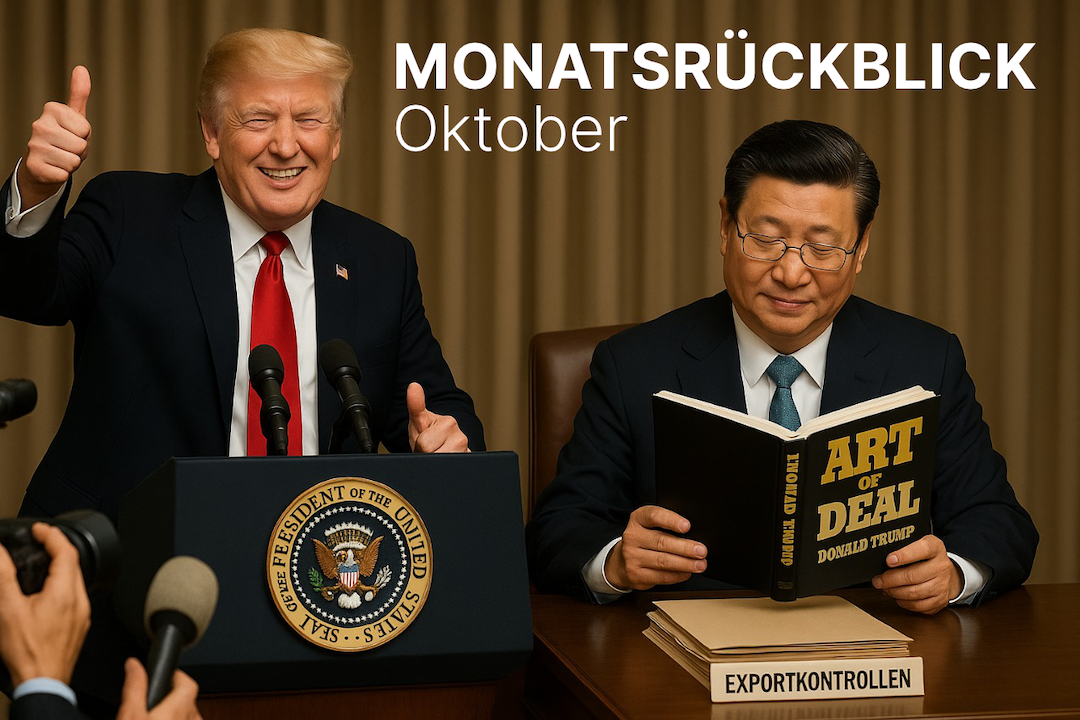
October 2025 was marked by significant tensions and challenges in global markets. An escalating trade war between the US and China, exploding commodity prices, and political maneuvering dominated events. These developments clearly demonstrated how fragile global supply chains are and how critical strategic commodity reserves have become.
An Almost Black Friday
Tension reached its preliminary peak on October 10. When US President Donald Trump announced an increase in tariffs on Chinese goods from 30% to up to 130%, stock markets worldwide experienced one of their sharpest declines. The S&P 500 plummeted by 2.7%, leaving investors with the anxious question of how far this economic war could escalate before it completely stifles the global economy.
In this heated atmosphere, our forecasts were impressively confirmed. During our presentation at the Industrieclub Düsseldorf, it became clear that our analyses had become reality: prices for rare earths exploded, deliveries from China became unpredictable, and those who invested early profited doubly – economically and strategically.
The price development of heavy rare earths, which are subject to export controls by China, provided irrefutable proof. Increases in dysprosium oxide (+88.55%) and terbium oxide (+90.89%) reached historical highs in October. Investors who had strategically placed their bets on these metals in time were able to enjoy significant gains.
Price Development in October 2025:
- Dysprosium Oxide: +88.55%
- Terbium Oxide: +90.89%
- Neodymium Oxide: +11.32%
- Gadolinium Oxide: +37.01%
The NEX® (Noble Elements Index), which tracks the price development of six important technology metals, also recorded a 5% increase in October compared to the previous month and now stands at approximately 320%.
The Unstoppable Demand of Future Industries
While the trade war raged, new insights underscored the fundamental importance of rare earths for key technologies. Our Head of Finance, Tim Borgschulte, brought crucial insights from the “Rare Earth Mines, Magnets & Motors” conference in Toronto. At this leading industry summit, it became clear which sectors have the greatest raw material hunger.
The results for the respective magnet growth markets are clear:
- Robotics: +24% annual growth
- Drones: +19% annual growth
- Electric Vehicles: +11% annual growth
However, without a secure supply of commodities such as neodymium oxide and praseodymium oxide, these ambitious growth targets remain mere pipe dreams. For Europe, it is more urgent than ever to fill its own reserves and secure its strategic position.
Europe's Hesitation and America's Resolve
The urgency of the situation was also reflected in the media debate. Headlines such as “Brutal Fight for Raw Materials” (FAZ) and “Trade War Threatens Millions of Jobs” (Focus) highlighted the growing nervousness. Indeed, the concern is justified: over 50% of DAX companies would be directly affected by an export stop on rare earths. But while Europe was still debating, the US created facts.
The US generally offers a better regulatory framework for companies like Pensana, a company specializing in the exploration, mining, and processing of rare earths with projects in Angola and the UK, which specializes in the processing and supply of rare earths. Purchase guarantees, minimum prices, and high funding sums – measures that should be part of a robust European raw material policy – are now being implemented in the US. At the same time, an important delegation trip to China with high-ranking representatives from politics and business, which our CEO Andreas Kroll would also have attended, was canceled. Additionally, the raw material fund, endowed with one billion euros, remained unused.
A Fragile Truce at Month-End
Towards the end of the month, all eyes were on the summit between Trump and Xi Jinping. A looming expansion of Chinese export controls on neodymium and praseodymium would have had fatal consequences for the European automotive industry. At the last minute, these measures were postponed for one year; in return, US President Trump slightly lowered tariffs as a concession.
Leading analysts, however, clearly assess the outcome of the negotiations: President Xi Jinping is considered the clear winner of this diplomatic maneuver. Our CEO Andreas Kroll also emphasized this in three extensive interviews – the US concessions could not compensate for Europe’s structural disadvantages, while China maintains central export controls and further strengthens its position in the global market.
But does this signify a real easing of tensions? Hardly. All other Chinese export controls remain in place. At best, it is a brief (maximum one-year) respite. The panic buying of critical metals like neodymium (+11.32%) is a clear sign that no one knows whether supply will still be secured next year.
The events of October 2025 have exposed strategic vulnerability. A reliable raw material supply is no longer a given, but a decisive factor for economic stability and technological progress.
Our CEO was even surprised to find himself on ZDF’s Heute-Show. This shows that the topic has finally entered the German consciousness. Almost everyone seems to understand that raw material scarcity hurts: The satirical show depicts a scene where a TV viewer hits himself on the head with a bottle after learning that there will be no more smartphones without rare earths. Does it really have to come to this?