Munich Security Conference 2026: Commodities Between Aspiration and Reality
The 62nd Munich Security Conference (February 13 to 15) is titled “Under Destruction”—a reference to the increasing erosion of international stability. Between broad discussions on world order and specific security policy issues, one panel made it clear just how much critical commodities have become a strategic factor.
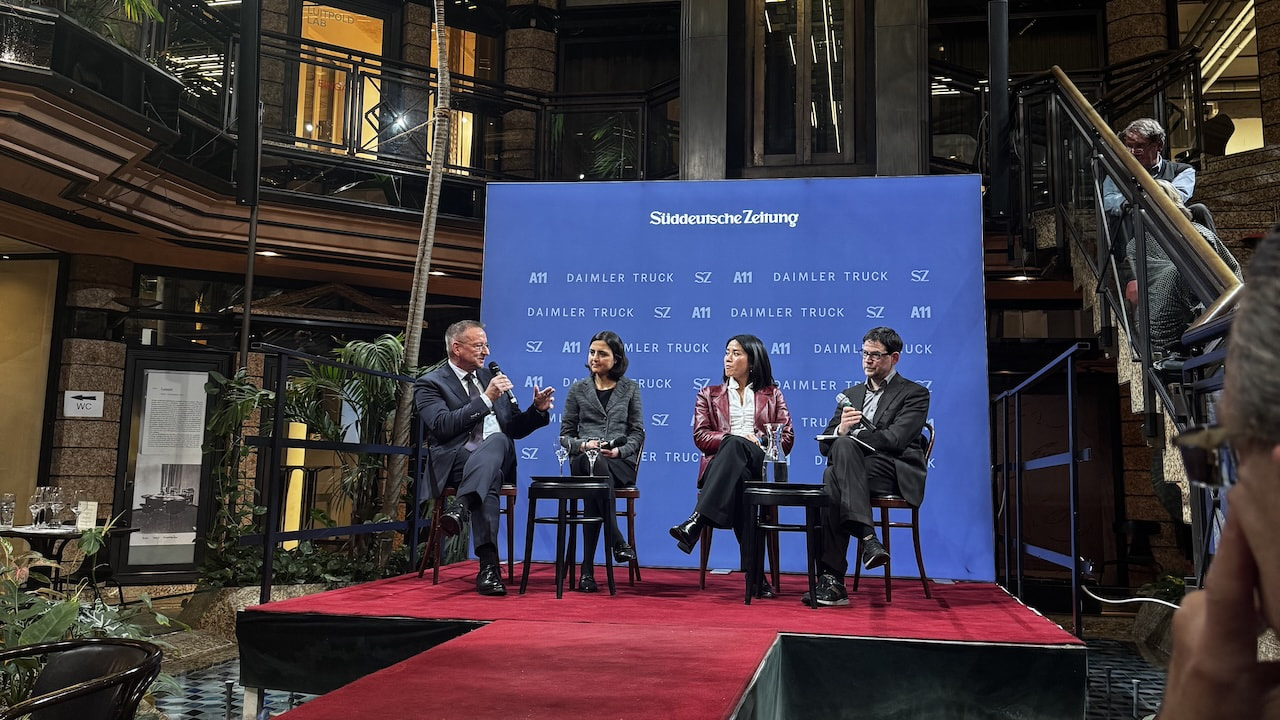
On the sidelines of the 62nd Munich Security Conference, the SZ Summit took place at Café Luitpold—an exclusive discussion format hosted by the Süddeutsche Zeitung in the heart of Munich.
It became clear there what was also emerging on the main stage of the Munich Security Conference: Critical commodities have long been core security infrastructure.
The focus was on three perspectives:
- Samina Sultan – on economic policy instruments and the question of how resilience can be strengthened through regulation
- Thuy-Ngan Trinh – on the technological dimension, particularly regarding resilient drone production and industrial innovation capacity
- Andreas Kroll – on the operational perspective from international raw materials trading
Policy, Technology – and Operational Reality
Samina Sultan outlined the regulatory framework:
What instruments exist against economic coercion? Which European diversification concepts are effective? And how long does it realistically take for such strategies to work?
Trinh added the technological perspective:
How can military security be ensured through technological leadership? Where do dependencies arise – for instance, in components from China – even when final production takes place in Europe?
Kroll brought a different dimension to the discussion: market mechanics and timelines.
“We Need Raw Materials Now”
One point of discussion was the question of why Germany does not rely more heavily on domestic deposits. Commodities are available – one simply needs to change the “mindset.”
Kroll challenged this oversimplification. Not fundamentally opposed to exploration, but against the expectation of quick results.
His arguments:
- Mining projects often require seven to ten years until operational production
- Approval processes, infrastructure, financing, and environmental regulations further extend the timeline
- Industry – particularly in the defense sector – is, however, under immediate procurement pressure
“It’s not about mindset,” was his message. “It’s about availability – and we need that now.”
Price Reality in the Defense Industry
Another aspect concerned the procurement situation in parts of the European defense industry.
Kroll reported that companies sometimes pay very high premiums to secure access to certain rare earths and strategic metals. The background includes trade restrictions, export regulations, and the strong concentration of refining capacity in China.
His assessment was pragmatic:
Europe will not be able to compete with Chinese production capacity in the short term – particularly in processing and refining.
This does not mean inability to act.
But it does mean that strategic planning must be more realistic.
How Close Are Production Shutdowns?
Kroll also described how export regulations work in practice:
Licensing requirements, delays, uncertainty in supply chains. In individual cases, Europe has already come very close to serious production interruptions.
Such situations demonstrate that supply chain stability is no longer an abstract issue, but has direct impact on industrial capacity.
Strategic Reserves as a Transitional Instrument
One point that gained weight in the panel was the establishment of strategic raw material reserves.
While diversification and new partnerships are intended to have long-term effects, stockpiles can create short-term stability. However, practical implementation is complex – both financially and regulatorily.
This made clear:
Resilience is not a political buzzword, but a matter of concrete infrastructure, financing, and coordination between government and industry.
Geoeconomics 2025/2026: Shifting Dynamics
In 2025, supply difficulties with rare earths dominated as a result of the US-China tariff dispute, as well as shortages of so-called legacy chips in the wake of the Nexperia crisis.
The situation has since become more complex. In addition to China, other actors are also perceived as strategic uncertainty factors. The international order is increasingly fragmenting.
The panel made clear:
Europe must not only diversify, but understand its raw materials strategy as part of its security architecture.
A Factual Assessment
Andreas Kroll’s contribution was less political than analytical. He argued from the perspective of a market participant who directly experiences trade restrictions, price distortions, and supply bottlenecks.
Precisely this operational perspective meaningfully complemented the theoretical and technological contributions.
The central insight of the panel:
Security policy does not end with defense budgets.
It begins with material availability.
And that is precisely where Europe’s actual resilience is determined.
It became clear what was also emerging on the main stage of the Munich Security Conference:
Critical commodities have long been core security infrastructure.