Gadolinium gallium garnet on the path to the (almost) power-free computer
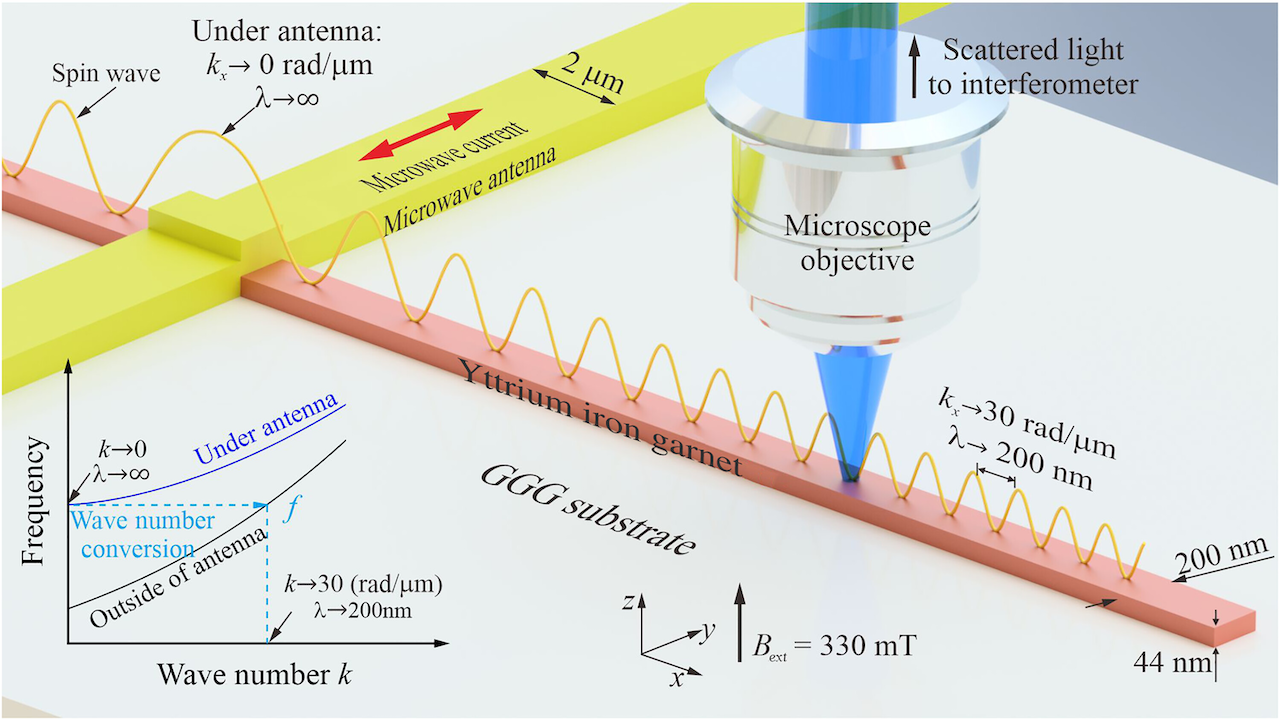
A discovery by a Viennese research team brings the development of (almost) power-free magnonic (non-magnetic!) PCs closer.
Magnonic computers transmit information via magnetic waves instead of electrical signals. Research into this has been ongoing for some time, as electron-based computers are increasingly reaching their limits. However, the (almost) power-free computers have not yet been realized. A new development by the ‘Nanomagnetism and Magnonics’ research group at the University of Vienna, utilizing Gadolinium Gallium Garnet (GGG), now brings fresh impetus.
Fast information transfer via short waves
The central role in magnonic computers is played by magnetic angular momentum that propagates through a material in the form of waves. The quasi-particles of these spin waves are called “magnons”. Until now, the greatest challenge in magnonics has been to reduce the wavelength of the spin waves. The shorter it is, the faster information is transmitted. So far, the wavelength could only be shortened using very complex hybrid structures or a synchrotron, i.e., a particle accelerator. Because such methods are very complex, research into magnonic computers has been stagnating for some time.
Intensity is the key
The Vienna research group’s new discovery is that the wavelength of spin waves can be changed via their intensity. The study’s co-author and head of the Vienna NonoMag team, Andrii Cumak, explains it in an easily understandable way with a metaphor: “It is helpful to imagine the method using light. If you change the wavelength of light, its colour changes. However, if you change the intensity, only the brightness changes. In this case, we have found a way to change the colour by changing the intensity of the spin waves. This phenomenon enabled us to excite much shorter and much better spin waves.”
An important step on the path to complex systems
So far, the researchers have been able to excite a wavelength of 200 nanometres. Simulations showed, however, that even shorter wavelengths are possible. In addition, the scientists succeeded in generating spin waves with a constant amplitude, which is important for the development of integrated circuits. These, in turn, are a key element in building more complex systems and thus ultimately in developing a fully functional magnon computer. This goal has not yet been achieved, but the journey continues.
Gallium and gadolinium are in-demand tangible assets
Gadolinium gallium garnet is produced synthetically and is frequently used by industry, for example in the manufacture of optical components.
Its key components gallium and gadolinium are highly sought-after, production-critical metals. As a tangible-asset investment, these commodities also offer an attractive investment opportunity with potential returns that is tax-free after a holding period of one year.