Europe's Critical Raw Material Turning Point:
Why New Alliances Are Now Decisive for Sovereignty
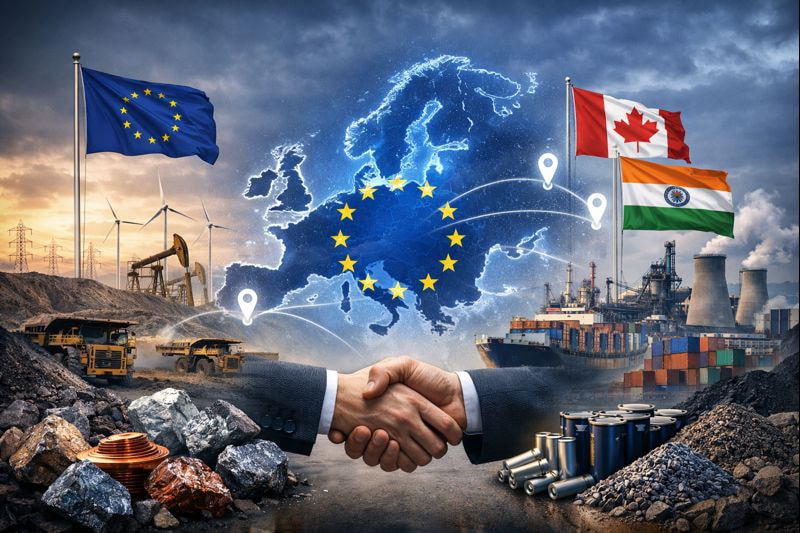
The World Economic Forum in Davos has signaled a clear shift in global dynamics. For Europe, this is a decisive moment. For years, international trade was based on principles such as globalization and cost optimization. However, recent developments show that this era of reliability is coming to an end.
What is dissolving is not global trade itself—but the assumption that it functions in a politically neutral manner. Europe is facing a realignment in which security of supply and geopolitical resilience take precedence over pure efficiency.
The Risk of Fragile Supply Chains
The structures that European industry has long relied on are noticeably shifting. China is increasingly tying its role as a central supplier of strategic commodities to political conditions. Export controls, approval reservations, and national prioritization complicate planning for businesses.
At the same time, the USA is pursuing a consistent “America First” policy. Economic policy reliability is therefore no longer a given, even for long-standing partners. The transition from free markets to defined spheres of influence poses a real challenge to Europe’s industrial sovereignty.
Strategic Partnerships as a Response
In this situation, new strategic options are opening up for Europe. The global reordering not only forces a reaction, but also enables proactive shaping.
Instead of managing existing dependencies, Europe can specifically expand partnerships with states that offer political stability, the rule of law, and transparent supply chains. Supply security arises where economic interests and political reliability converge.
Strategic alliances do not replace the market – they stabilize it where market mechanisms alone are no longer sufficient.
Canada: A Reliable Raw Material Partner
One of the most obvious opportunities lies in a deepened partnership with Canada. The country possesses significant deposits of strategic commodities, a stable political order, and clear regulatory frameworks. High ESG standards and transparent supply chains make Canada a credible partner for long-term supply security.
The recent tensions between the USA and Canada also offer Europe the opportunity to position itself as a reliable strategic partner – not opportunistically, but with a long-term perspective.
India and Mercosur: Leveraging Geopolitical Influence
Strategic opportunities also lie beyond traditional commodities suppliers. While India is not yet a central exporter of critical commodities, it plays a key role between power blocs. Furthermore, the country has growing processing capacities, for example, for rare earths. A free trade agreement thus not only strengthens economic relations but also Europe’s geopolitical resilience.
The Mercosur agreement, in turn, offers access to commodities and sales markets at the same time. Not signing it would mean giving up strategic space – with the consequence that other actors would fill this void.
Think Long-Term, Act Now
Raw material security is no longer a minor issue of trade policy. It determines industrial capacity, economic stability, and political sovereignty.
Europe faces a strategic decision: Those who deepen partnerships now create room for maneuver for decades. Those who hesitate accept growing dependence.