De-dollarization: Is a New Financial System Emerging in the Shadow of the Dollar?
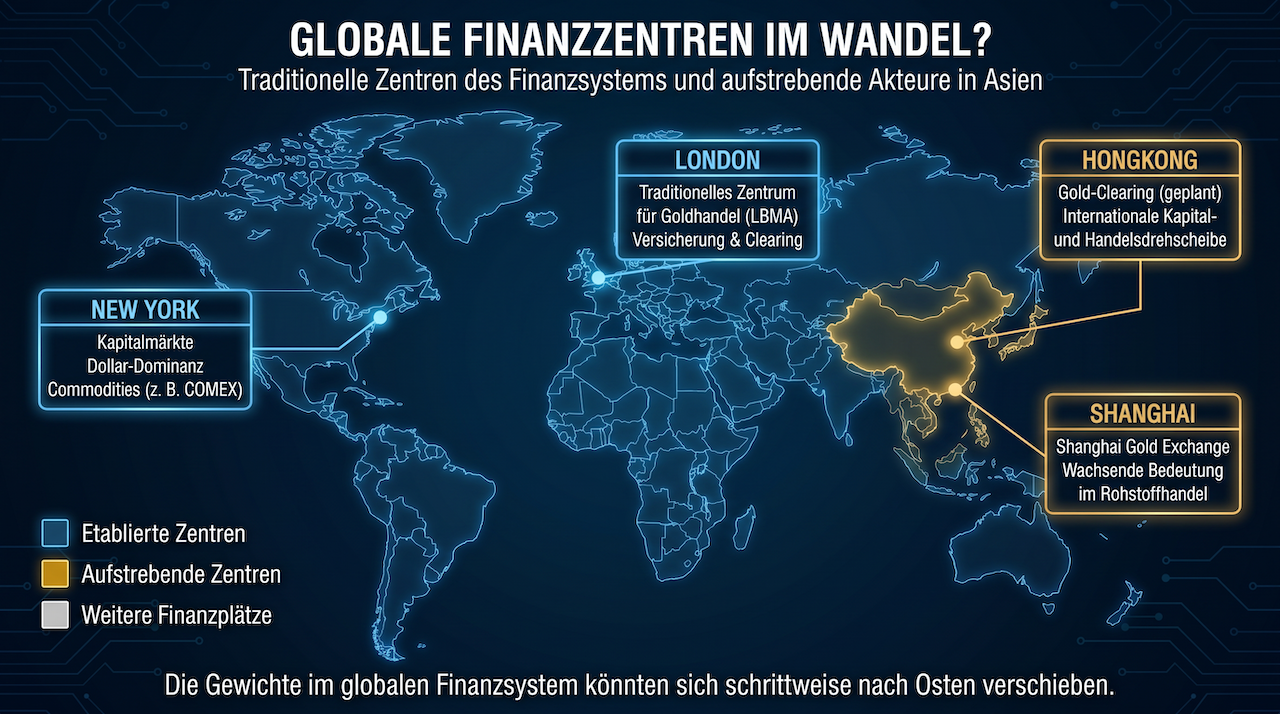
Gold clearing in Hong Kong, record purchases by central banks, and alternative payment systems: At first glance, these developments appear to be unrelated. But taken together, they could signal a profound shift in the global financial architecture.
For decades, the U.S. dollar has been the cornerstone of the international financial system. Commodities are primarily traded in dollars, international payments are largely processed through Western-dominated financial infrastructures, and the most important gold trading centers are located in London and New York.
But the world is changing.
More and more countries are trying to reduce their economic dependence on the dollar. Central banks are buying more gold than they have in decades, the BRICS countries are working on alternative payment systems, and China is systematically expanding its financial and trade infrastructure. Against this backdrop, one piece of news is drawing particular attention: Hong Kong is establishing its own gold clearing system.
Taken on its own, this may seem like a technical innovation. In the broader context, however, it could be another building block in a trend that extends far beyond the gold market.
De-dollarization does not mean the end of the dollar
The term “de-dollarization” is often misunderstood. It does not necessarily refer to an attempt to replace the U.S. dollar as the world’s reserve currency. Rather, for many countries, it is about reducing their dependence on a single monetary and financial system.
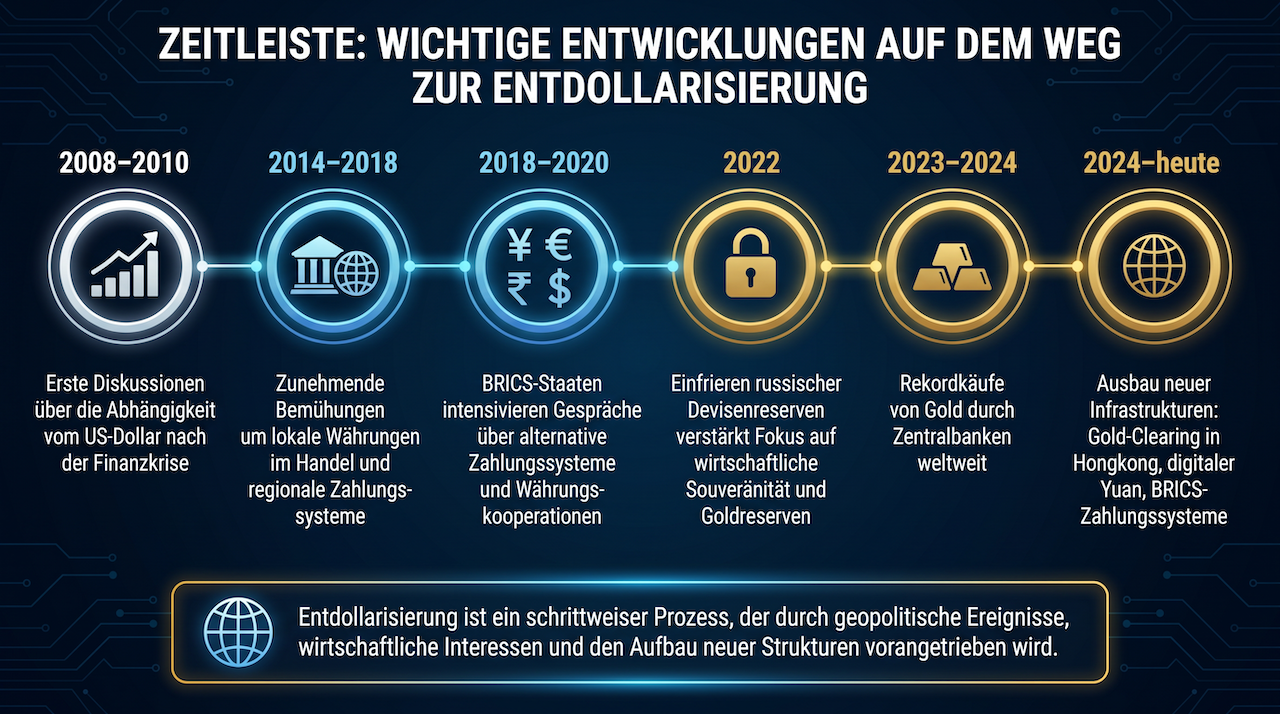
Ever since Russian foreign exchange reserves were frozen in 2022, many governments have come to realize that economic power today can be exercised not only through currencies but also through financial infrastructure.
In this environment, gold takes on new significance. It is not a claim against a government, cannot be created at will, and is accepted worldwide as a store of value. Accordingly, central banks have massively expanded their gold reserves in recent years—to their highest level in decades.
Why Hong Kong?
Officially, Hong Kong’s goal in implementing the new gold clearing system is to expand its role as an international precious metals hub.
A clearing system ensures that gold transactions between banks and institutional market participants are settled securely and efficiently. It provides liquidity, reduces risks, and forms the foundation for a functioning international market.
But perhaps there is more at stake than just a more efficient gold trade.
Alongside the expansion of its precious metals infrastructure, Hong Kong is working to further enhance its appeal as an international financial center. According to media reports, among other things, authorities are exploring ways to provide Chinese investors with greater access to international assets and to further strengthen the city’s position as a hub for global investors.
Taken individually, these are different measures. Taken together, however, they paint a picture of a financial center that aims to expand its capital, trade, and infrastructure simultaneously.
A puzzle with many pieces
The gold clearing system is not the only development that deserves attention at the moment.
At the same time, additional structures are being established around the world:
- The BRICS countries are working on alternative payment systems for international trade.
- China is steadily moving forward with the digital yuan.
- The Shanghai Gold Exchange is gaining international prominence.
- Assets such as gold are increasingly being digitized and tokenized.
- Central banks are purchasing record amounts of physical gold reserves.
- Hong Kong is actively expanding its role as an international financial center.
None of these developments, taken on its own, proves that there has been a fundamental shift in the financial system.
Taken together, however, they paint a remarkable picture: More and more countries are investing in structures that could make international trade and capital flows less dependent on Western-dominated financial systems.
Could gold play a new role in this?
There is repeated speculation about a gold-backed BRICS currency or digital gold tokens.
To date, there is neither an official gold-backed BRICS currency nor a common cryptocurrency for the group of countries.
Still, it’s worth taking a look at the requirements.
Anyone who wants to establish digital, gold-backed financial products needs physical gold, secure storage, transparent proof of ownership, and efficient clearing systems. These are precisely the areas in which investments are currently being made.
It remains to be seen whether this will one day lead to new international billing models. One thing is clear, however: the necessary infrastructure is already being put in place in many places.
More than gold?
Perhaps this is exactly where the real story lies.
Are all these developments really just about gold? Or are we witnessing the gradual establishment of an alternative financial and trading infrastructure?
For years, China has been pursuing the goal of strengthening its position along strategic value chains—from rare earths to technology metals to battery raw materials. At the same time, the country is investing in trading platforms, payment systems, digital currencies, and capital market structures.
That does not necessarily mean that all of these projects are part of an overarching master plan. Each project initially pursues its own economic and political goals.
Nevertheless, it is striking that many of these developments complement one another. Commodities, capital markets, payment systems, and trade infrastructure are becoming increasingly intertwined. It is precisely this interconnectedness that could, in the long term, determine which financial centers will shape international trade in the future.
What does this mean for Europe?
In the short term, there is no reason to expect that Europe and the U.S. will see their financial centers lose their significance. London remains one of the world’s most important gold trading centers, and New York continues to dominate large parts of the international capital market.
In the long term, however, the question may arise as to who will control the infrastructure of tomorrow’s global trade.
After all, economic power does not arise solely from capital or commodities. It also arises from stock exchanges, clearinghouses, payment networks, and trading platforms. Those who provide this infrastructure often set the rules by which markets operate.
A Look Ahead
It is impossible to say with any certainty today whether Hong Kong will one day pose serious competition to London. It is equally unclear what role BRICS payment systems, the digital yuan, or tokenized gold products will actually play in the future.
One thing is certain, however: It is no coincidence that the world is currently investing in gold, alternative payment systems, and new financial infrastructure.
Perhaps that is why we are not witnessing the emergence of a new global currency.
Perhaps we are witnessing something more fundamental—the gradual development of a financial system that will, in the future, be based on multiple centers of power.
If this trend continues, the new gold clearing system in Hong Kong would not be the main story. Rather, it would be one of the first visible building blocks of a development whose full implications may not become apparent for several years.