Commodities prices are at their lowest in decades—and why hardly anyone believes it
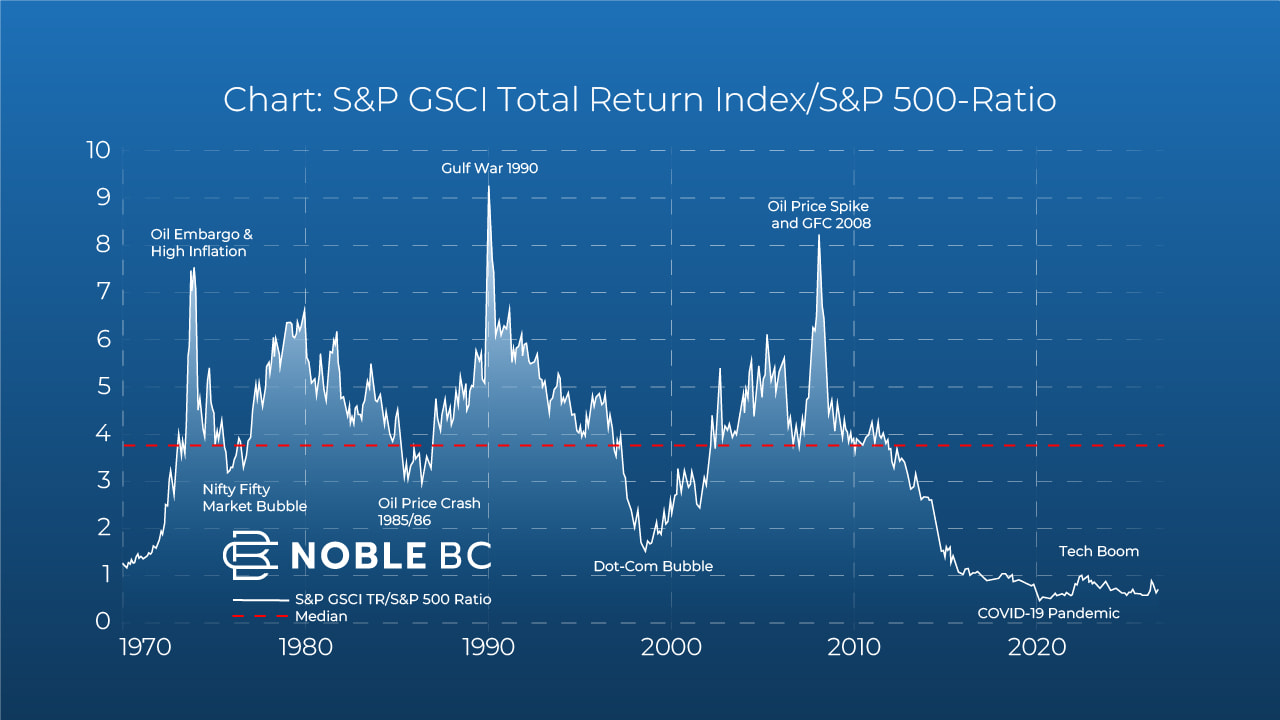
We’re paying exorbitant prices at the gas station, while grocery shopping is getting more and more expensive. Anyone who claims right now that commodity prices are historically low may be met with skepticism, but from a macroeconomic perspective, they’re right.
Why High Gas Prices Say Little About Commodity Valuations
At the gas station, we see a consumer price that includes not only crude oil but also refining, transportation, exchange rates, levies, and taxes. In the commodities market itself, pricing works differently. Gold, oil, and copper are priced on international trading platforms. For germanium, gallium, and rare earth elements, prices are determined by offers and transactions between producers, traders, and industry, with China often playing a key role. As the dominant producer and processor, the country can significantly influence the markets through production volumes, state-supported capacity, and export licenses. However, even China cannot permanently override the major cycles of the commodities market. Especially since the West has long been working on its own countermeasures: supply chains outside of China and minimum prices for strategic raw materials.
Commodities are historically cheap compared to stocks
The long-term comparison with the S&P 500 is clear: commodities are at their cheapest levels in decades. The valuations of these two asset classes have diverged significantly. Such divergences can persist for a long time. However, they were not sustained over the long term in previous commodity cycles.
During the major price swings of the past, two mechanisms recurred: wars, embargoes, and blocked trade routes caused supply shortages. Industrial and technological upheavals, on the other hand, generated demand for which the market was unprepared. Today, both developments are converging. This is what makes the wide gap between commodity and stock markets so remarkable—and potentially significant.
One reason for this gap lies in the index itself: About 40 percent of the S&P 500 now consists of technology and AI stocks, and an increasing number of voices view this very concentration as a bubble that will eventually burst, just like every major bubble before it—whether in real estate or the dot-com era. When stocks become too risky for many investors, they typically seek refuge in tangible assets, and commodities have traditionally been among them. Demand for a limited commodity then rises, while supply barely keeps pace. Prices are already high today, but they are still far from reaching their peak—even if it’s impossible to predict with any certainty when and how that will happen.
A New iPhone Moment and Why It Affects Commodities
When Apple introduced the iPhone in 2007, existing technologies came together in a single device, giving rise to an entirely new market. Today, the global industry is facing a comparable moment, only on a significantly larger scale.
Artificial intelligence, humanoid robotics, and quantum computing are increasingly converging, thereby altering the military balance: AI is already accelerating cyberattacks, while powerful quantum computers could one day break the encryption of military systems. This further intensifies the technological race among major powers for semiconductors and autonomous systems. At the same time, the power demand of data centers is growing faster than power plants, storage facilities, and grids can be expanded.
All of this is creating a massive demand for high-purity specialty metals and strategic commodities. However, new mining and processing capacities can be built up much more slowly than technological demand is growing. So far, this development has had little impact on commodity prices relative to stocks. Commodities remain historically cheap, even though AI, robotics, data centers, and new energy systems are already generating an enormous additional demand for materials.
Added to this is a structural problem: Many of the critical commodities needed for these applications are produced only as byproducts of tin, aluminum, or copper production. Their extraction cannot be ramped up at will without flooding the respective primary markets and rendering them unprofitable. This further limits supply, especially when
demand is rising the most.
The German automotive industry illustrates just how quickly an industry can fall behind. Automotive expert Philipp Raasch described on Markus Lanz’s show three waves of technology to which the industry had reacted too late: batteries, software, and AI. The industry is now five to six years behind. When it comes to commodities, such a delay would be nearly impossible to make up, as new extraction and processing capacities often take even longer to develop.
Rising demand meets fragile supply chains
Just how vulnerable these supply chains are is currently becoming apparent in several areas. In the Strait of Hormuz, a war threatens the route used for about one-fifth of the world’s traded oil. At the Panama Canal, a lack of rain is enough to limit the amount ships can carry, and starting in September, fewer transits will be possible. When it comes to technology metals, a Chinese export license can sometimes determine whether the material is delivered at all.
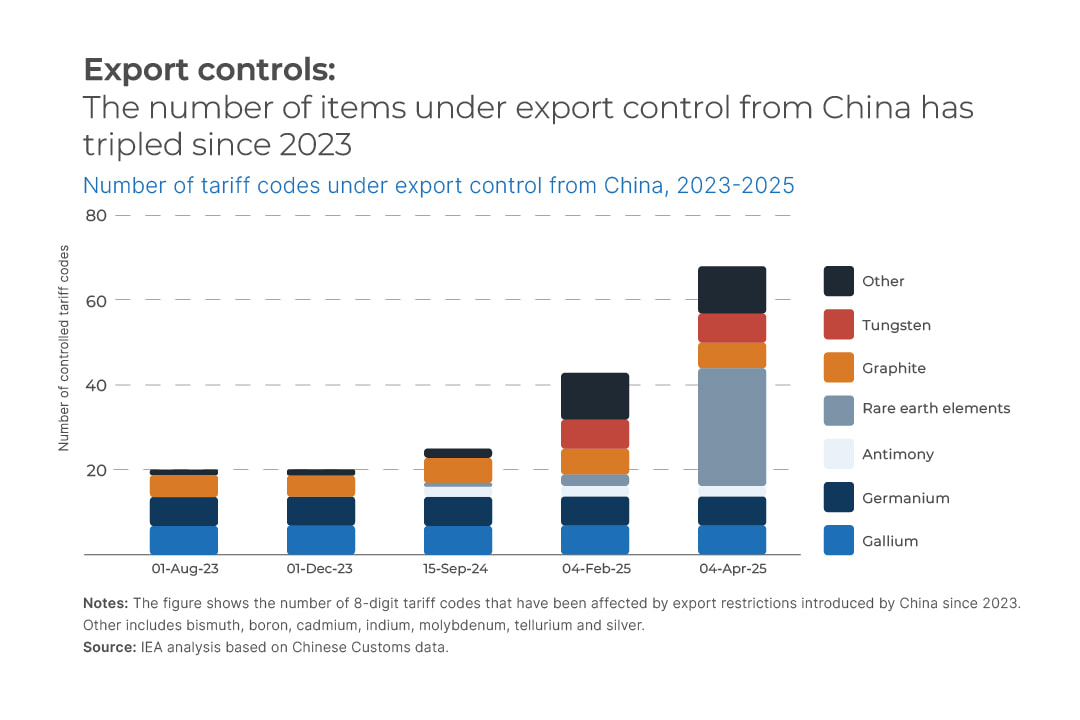
The country’s own customs data shows just how consistently China is now using this tool. On August 1, 2023, the International Energy Agency counted approximately 20 tariff lines subject to Chinese export controls. By April 4, 2025, this number had more than tripled to just under 70. Rare earths now constitute by far the largest single category, ahead of tungsten, graphite, antimony, germanium, and gallium. What was still a peripheral tool of trade policy in 2023 has become a central lever within two years.
On November 10, the suspended controls could take effect again. We have already reported in detail on the potential consequences for German industry in this article.
Even a single one of these disruptions can have a significant impact on prices and delivery times. If several occur simultaneously and coincide with the growing demand from AI, robotics, drones, and new energy infrastructure, reserves will dwindle rapidly. Current prices have so far reflected only to a limited extent just how uncertain access to many commodities has become. This is precisely where the key tension lies: Commodities are historically cheap compared to stocks, even though supply risks are increasing.
The competitive edge starts with the commodity
The historically low valuation of commodities is no guarantee of rising prices, but there are many signs pointing in that direction. Commodities are cheaper relative to stocks than they have ever been. Should the valuation bubble in the stock markets actually burst, this very gap is likely to become the decisive factor: capital will then seek refuge in tangible assets, and commodities will be among the first choices. This is by no means certain; it is more of a hunch about what might lie ahead. However, it already offers companies the opportunity to diversify their supply chains, build up inventories, and secure processing capacity before technological demand grows further. Once scarcity begins to drive up prices, this head start will come at a high cost—or may already have been lost.
Physical strategic commodities differ fundamentally from purely financial assets: they are needed for real industrial applications. However, the selection of the material, its quality, ownership structures, and secure storage are crucial.
Scarcity and geopolitics are not the only factors at play. Climate change is also having an increasing impact on commodity prices, whether through droughts that hinder extraction and transportation or through the expansion of renewable energy, which itself consumes metals. As diverse as these factors are, they all point clearly in the same direction: rising prices.
There are many indications that the next industrial “iPhone moment” is drawing nearer. It is impossible to predict when the commodity markets will react to this. However, companies should not wait until shortages become apparent before taking action. Because no matter how long the journey is, it always begins with the commodity.